
Business update, week 6
August 31, 2025 at 6:01 PM
Hi everyone,
This week I took a step back from my language flashcard app and came up with a new $10 product idea. I built a landing page to sell it and started marketing the product to my LinkedIn network. I made 1 sale to a complete stranger and feel confident that I can make more sales, but I fell short of the goal I set of 2 sales to strangers.
Here are the details:
What goals did I set last week and did I meet them?
Main goal: Launch a new $10 offer and make 2 sales to strangers, applying some of the interview feedback and lessons learned last time around
Result: Partial success. I came up with a new $10 offer, shared it publicly, and within a few hours, a complete stranger pre-ordered it. However, in the next couple days, nobody else signed up. I’ll go into more detail below, but I’m fairly confident I can hit my ‘10 sales of a $10 product’ milestone with this offer in the next week or two. But I fell one sale short of hitting this week’s goal.
What did I do this week?
First, here’s a quick recap of what I’ve been working on in August:
I’m taking an online course, aimed at helping me earn my first $1000 online. The class is structured as a series of increasingly difficult missions. You have to complete each mission before you can access the materials for the next one.
Mission 1 was to earn $1. Mission 2 was to earn $10 by selling some type of online product. Mission 1 was trivial (thank you everyone 🙂) and Mission 2 only took a few days.
Mission 3 is to sell a $10 product 10 times, earning $100 dollars. I’ve been stuck on this one for a few weeks now
My original $10 offer was access to a tool that helps you create language flashcards quickly. This solved a very specific problem that I’ve dealt with, and when I posted the idea in my class’s community forum, someone else signed up for it.
I built the tool to fulfill that order, but didn’t think I’d be able to get more people to sign up for it. So I spent the next two weeks trying to add features and talking to lots of language learners in my network to try and figure out if there was a better, similar product in the language learning space I could build.
Last week I decided that I was going too deep down a rabbit hole working on that tool, and decided to work on something different for now to try and progress through the class. My goal for this week was to try and apply some of the things I’ve learned so far and come up with a new $10 product to sell.
That’s the context for what I spent this week working on.
Came up with a new $10 product idea
Okay I actually need to give a bit more context 😄
In 2023 I started doing ‘forecasting tournaments’ for fun on a site called Metaculus. Forecasting in this context means estimating the probability that various things will/won’t happen. Platforms like Metaculus pose questions across a range of subjects - geopolitics, technology, economics… really anything (if you’re confused, browse Metaculus for a few minutes and you should get a sense for what I’m talking about). They aggregate the forecasts submitted by their users to create highly accurate estimates for the likelihood of different events.
Metaculus is one site within a broader forecasting ecosystem that also includes prediction market platforms like Manifold (fake money), Kalshi (real money), and Polymarket (real money).
Randomly, I turned out to be very good at forecasting, and I won the first two tournaments I entered and built up a very strong track record over the course of the next year. I ended 2023 as the #3 ranked forecaster on Metaculus.
With that in mind… I had the idea of making a Forecasting 101 guide, a distillation of everything I learned throughout two years of forecasting. I made a landing page that describes the product, and includes a pre-order button. I set the ‘release date’ far enough away that if I get pre-orders I will have time to create the guide.
This idea has a few advantages over the language learning stuff:
- I have direct experience with forecasting and can speak credibly and confidently on what works and what the challenges are.
- I have real credentials in this space that very few other people have (track record, tournament wins, blogged about it for a while)
- The target audience for the product is much narrower than with my language learning tool. “This product helps new/struggling forecasters get better results.” I didn’t have a clear mission statement like this for my language flashcard tool.
- I have been the target customer, and experienced the transformation that this customer wants: new to forecasting > winning tournaments. So I have a good sense of how to get the customer where they want to go.
Built up my LinkedIn network
I published the landing page for Forecasting 101 on Wednesday evening, then spent Thursday to Saturday expanding my LinkedIn network within communities where my product might be relevant.
I have another advantage here which is that I’m already well connected within this space because of my previous blogging and tournament wins. The CEO of Metaculus has reached out to me in the past and I’ve talked to some of their other team members.
Each day, I spent about an hour sending out LinkedIn connection requests to people within forecasting-related companies, users from Metaculus or other forecasting platforms, and people who interact with forecasting-related content from other accounts. I’d estimate roughly 2/3 of the requests I sent out have been accepted. I assume that having lots of previous connections with prominent people in the forecasting community is making it much easier to get new connections.
Made educational posts about forecasting, with a link to the guide at the end
In tandem with growing my network, I’ve also started making daily forecasting-related posts on LinkedIn. Here’s one example. My goal is for these posts to be useful, insightful commentary on the topic of forecasting. Then at the end of the post, I mention that I have a Forecasting 101 guide and if you found this post useful, you may be interested in the guide.
The idea is that if someone clicks on the post, reads it to the end, and finds it interesting, they are likely to be the type of person who would find the forecasting guide useful. I generally want to avoid making posts just directly selling the product - rather, I want to demonstrate that I’m knowledgeable about the subject and have compelling things to say.
Sale #1 and moving forward
About two hours after my first post, a complete stranger pre-ordered the guide. I continued growing my network and made another two posts on Friday, but didn’t get any additional orders. At this point it’s just way too early to draw many conclusions. The fact that I had one buyer after about 20 readers of my first post seems promising though.
The plan for next week is to continue putting daily effort into growing my network and making interesting posts about forecasting. Another week or two of doing this should give me a clearer signal of whether this is actually something people are interested in.
I should mention that this approach (pre-order page » post relevant content » grow your network) is the strategy recommended by the course I’m taking. Whether or not this is a marketing strategy I use long term, it’s helpful to have a product that fits more naturally within the structure of the course, which wasn’t really the case with my language stuff.
Again, my objective with the course is to learn lots of skills relevant to business and complete all the challenges, not necessarily to start my ‘forever business’. I’m hopeful I can hit the $100 milestone with my forecasting guide, but either way it’s a good learning experience.
What’s working and what isn’t?
I was very focused on the ‘main goal’ this week and thought I was working efficiently towards that goal, but still didn’t get the outcome I wanted. In other words, I did all the right things, but didn’t hit my weekly goal.
With that in mind, I’m going to try making my goals more ‘input based’ rather than ‘outcome based.’ My inputs - the places I was directing my effort, the things under my control - were good, whereas whether or not I achieved two sales was largely out of my control.
A better way of framing the goal for this week would have been “come up with a new $10 product idea, share it publicly, and put daily effort into growing the number of people that see it.” The aim is the same - get strangers to buy my product (or determine that the product isn’t something people want) - but this formulation puts achieving the goal firmly in my control. The limiting factor is my focus and effort.
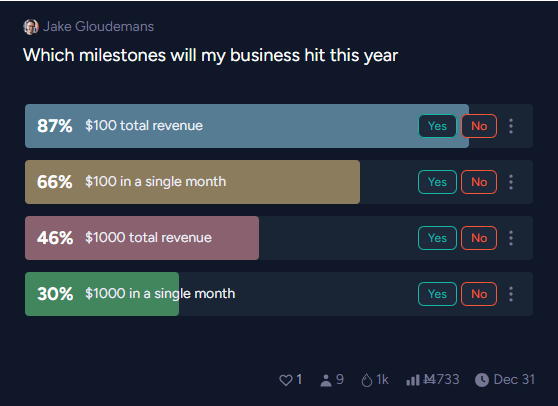
I want to separate milestones from goals. Milestones are the outcomes I’m aiming for. Goals are the actions I’m taking to reach those milestones. It’s important to make sure that the goals I’m setting are actually moving me towards the milestones - that’s one purpose of these weekly updates. But especially early on, when the most important thing is to take consistent action and learn by doing, I don’t want to de-motivate myself by setting goals that are out of my control.
What are my goals for next week?
Main goal: Write rough draft of Forecasting 101, add 10 LinkedIn connections each day, make 1 LinkedIn post each day
Bonus goal: Finding mentors to learn from could be very beneficial. I should put some effort into connecting with people who have been in my position before and gone on to be successful.
I'm moving apartments this week, I think I'll have time to do all this but I'll have less time than usual this week for work.
Final thoughts
I’m continuing to learn quickly and do things that are outside my comfort zone. I’ve made less progress than I’d like in terms of ‘coming up with a great product idea’ and ‘making actual money,’ but given that this is all very new for me I have to trust that consistent effort will eventually get me there, even if the beginning part feels slow.
Until next week,
Jake